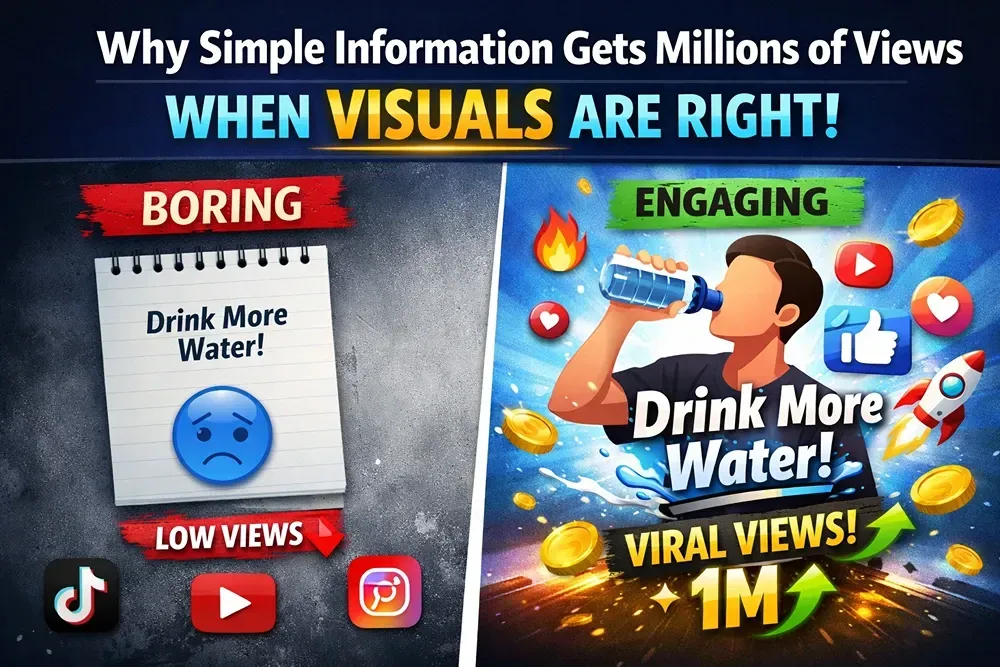
Why Simple Information Gets Millions of Views When Visuals Are Right?
The Psychology Behind Visual-First Content
Why Simple Information Gets Millions of Views When Visuals Are Right?
The Role of Hooks, Thumbnails & The First 3 Seconds
How Visual Storytelling Makes Basic Content Go Viral?
How to Create High-Engagement Visual Shorts Using GetShorts?
Ques1. Can Boring Topics Really Become Viral With The Right Visuals?
Ques2. How Important Is Video Pacing In Short-Form Content?
Ques3. Do Captions Increase Engagement In Short Videos?
Ques4. Why Do Viewers Replay Simple Informational Videos?
Ques5. How Can Testing Improve Short-Form Video Performance?
In today's fast-scrolling world of TikTok, Reels, and Shorts, something surprising happens: simple information is getting millions of views. No complicated tutorials. No overly technical breakdowns. Just clear, basic ideas presented well.
So what's the secret?
The answer lies in visual storytelling for short-form videos. When visuals are powerful, even the most basic information becomes engaging, memorable, and highly shareable.
In this detailed guide, we'll explain the psychology, platform behaviour, algorithms, and strategies behind viral short-form content, and how you can use tools like GetShorts to do it.
The Psychology Behind Visual-First Content
Humans process visuals 60,000 times faster than text. People often decide whether to watch based on what they see before they even read your caption.
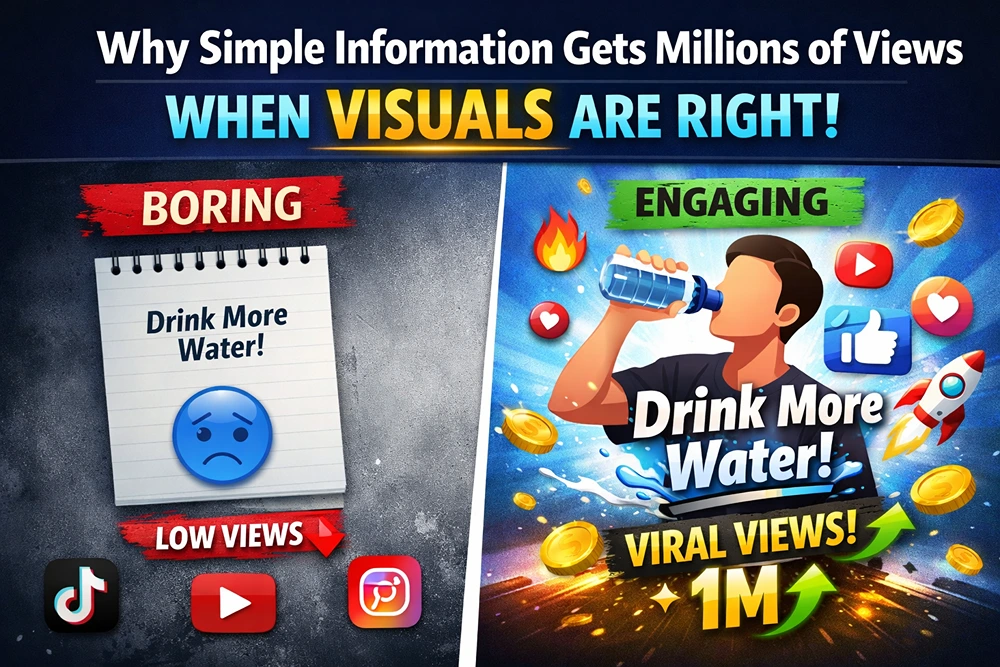
On platforms like TikTok and Instagram Reels, users scroll at lightning speed. Your video is less than 3 seconds long:
Grab attention
Trigger curiosity
Promise value
That's why engaging on social media through visuals is more powerful than ever. Bright colours, movement, contrast, captions, animation, these things instantly signal that your content is worth paying attention to.
Simple information works because it's easy to understand. Strong visuals work because they're easy to notice.
When the two combine, you have viral potential.
Why Simple Information Gets Millions of Views When Visuals Are Right?
Short-form platforms are designed for fast consumption. The algorithm favors content that:
Gets watched fully
Gets replayed
Gets shared
Gets commented on
Difficult information requires effort. Effort reduces retention. Failure to remember leads to loss of access.
But easy information?
It’s digestible
It’s relatable
It’s easy to consume in under 30–60 seconds
Therefore, viral short-form video techniques focus on clarity, not complexity.
Examples of simple yet viral topics:
Drink water first thing in the morning
One habit that changed my life
3 mistakes killing your productivity
Why do you feel tired after eating
These aren't difficult ideas. But when combined with dynamic captions, stock footage, motion graphics, and a strong hook, they're powerful.
The lesson? Simplicity wins. Presentation multiplies it.
The Role of Hooks, Thumbnails & The First 3 Seconds
If visuals are the engine, then the hook is the ignition.
The first 3 seconds determine whether someone will keep watching or scroll away. This is where thumbnail and hook optimization become crucial.
A powerful hook can be:
A bold statement: “You’re wasting 5 years of your life.
A curiosity gap: “Nobody talks about this productivity trick.
A relatable pain point: “Why you’re always tired (even after 8 hours of sleep).
But here’s the catch: even a great hook fails without visual reinforcement.
Imagine this:
Hook: “This habit is ruining your focus.”
Visual: Static background with plain text.
Now compare this:
Hook: Same text
Visual: Fast-cut clips of distractions, animated captions, zoom effect, and slight motion in the background.
Same words. Completely different engagement.
That's the power of visual storytelling for short-form video.
How Visual Storytelling Makes Basic Content Go Viral?
Visual storytelling is all about capturing attention.
It's not just about beautiful graphics, it's about creating a flow:
The problem appears visually
Tension builds
Solution is revealed
Visual proof reinforces the message
For example, a simple topic like:
“Why do you feel unmotivated?”
A viral visual structure could look like:
Clip of someone lying in bed scrolling
Fast text overlay: “It’s not laziness
Switch to stimulating footage
Reveal: “Your dopamine is overloaded.
Quick, animated bullet-point solutions
Suddenly, basic psychology becomes engaging content.
That's why short-form video content creation tools that offer stock visuals, captions, transitions, and audio syncing are a game-changer for creators.
Because the value isn't in the complexity, it's in the packaging.
How to Create High-Engagement Visual Shorts Using GetShorts?
If visuals are so important, the next question is: how do you create them well?
This is where GetShorts becomes powerful for creators.
Instead of spending hours manually editing, creators can:
Convert scripts into ready-to-publish shorts
Add dynamic captions automatically
Test different hooks quickly
Experiment with pacing
Optimize visuals for platform engagement
Because in short-form content, speed matters.
A major part of viral short-form video techniques is testing variations:
Different hooks
Different intro visuals
Different pacing styles
Different CTA placements
When creators can iterate quickly, they discover what works faster.
And when visuals are optimized around simple, high-demand topics, the results multiply.
The Future of Visual-Driven Short-Form Content
As attention spans shrink and competition increases, visual quality will become even more important.
Trends already showing growth:
AI-powered video creation
Caption-heavy short videos
Fast-paced micro storytelling
Faceless niche pages
Data-driven hook testing
Creators who master visual storytelling for short-form videos will shine.
Not because their ideas are revolutionary. But because their presentation is compelling.
Conclusion
The biggest misconception about content creation is that you need new ideas to go viral.
You don't. You need:
Clear, simple information
Strong visual packaging
Optimized hooks
Fast iteration
When simple ideas are combined with powerful visuals, they capture attention. In a world of information overload, clarity stands out.
In a world of endless scrolling, visuals stop thumbs. And when the two combine, millions of views are possible.
If you're serious about growing on TikTok, Reels, or Shorts, focus less on making the information complex and more on making the visuals engaging.
Because simple content isn't weak.
It can be enhanced.
And when the visuals are right, there's no stopping it.
FAQ
Ques1. Can Boring Topics Really Become Viral With The Right Visuals?
Ans - Yes. Even “boring” topics can perform well if the visuals are engaging. Fast cuts, motion graphics, dynamic captions, and emotional pacing can transform even mundane information into attention-grabbing short-form content.
Ques2. How Important Is Video Pacing In Short-Form Content?
Ans - Pacing is crucial. Slow transitions and long pauses reduce retention. Quick scene changes, gentle zoom effects, and well-timed captions help maintain viewer interest and improve completion rates.
Ques3. Do Captions Increase Engagement In Short Videos?
Ans - Absolutely. Many users watch videos without sound. Clear, bold captions improve accessibility, increase watch time, and strengthen visual storytelling for short-form videos.
Ques4. Why Do Viewers Replay Simple Informational Videos?
Ans - Viewers rewatch content when it's easy to understand but still offers value. Clear visuals and concise messaging encourage repeat viewings, which signals stronger engagement to the algorithm.
Ques5. How Can Testing Improve Short-Form Video Performance?
Ans - Testing different visuals, hooks, and pacing styles helps determine what makes viewers stay longer. Small visual adjustments can significantly improve video retention and overall video reach.


