Hook + Visual Combo: Why Good Content Fails Without Strong Visuals?
Why Strong Hooks Alone Don’t Guarantee High Watch Time?
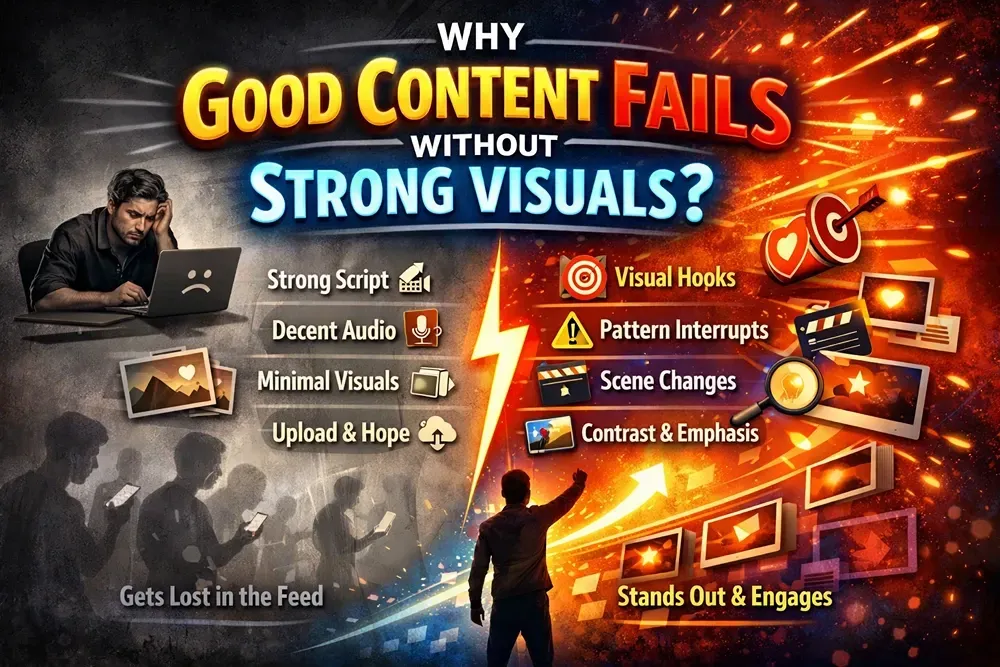
Why Good Content Fails Without Strong Visuals?
The Psychology Behind Scroll-Stopping Visual Content
How Visual Storytelling Boosts Retention and Engagement?
Why Faceless Videos Need Powerful Visual Structure?
Why Good Content Fails Without Strong Visuals?
How AI-Generated Visuals Are Changing Content Creation?
How to Improve Your Visual Strategy Today?
Ques1. Why Do Strong Visuals Matter In Short-Form Content?
Ques2. Can A Good Hook Alone Make A Video Go Viral?
Ques3. How Often Should Visuals Change In A Short Video?
In today's fast-scrolling world, attention is currency. You can write the smartest script, share the most valuable insights, and create a compelling hook, but if your visuals are weak, your content will still fail.
Many creators struggle with low views, poor watch time, and low engagement, not because their ideas are bad, but because their visual execution doesn't match their message.
This is where the hook + visual combo becomes powerful. A strong hook grabs attention. Strong visuals keep it.
Let's understand why good content without strong visuals fails and how creators can fix it by using better visual storytelling, smart design structure, and AI-powered tools like GetShorts.ai in short videos.
Why Strong Hooks Alone Don’t Guarantee High Watch Time?
Every content expert talks about hooks. And yes—hooks matter. The first three seconds determine whether someone will scroll or stay.

But the truth is:
A hook opens the door.
Visuals determine whether people will come in or not.
You may start your video with:
This is why most creators fail.
Nobody talks about this growth trick.
You’re losing views because of this mistake
Sounds strong, right?
Static
Boring
Random stock footage
Plain talking head with no movement
Viewers lose interest fast.
Increased watch time and audience retention depend on visual stimulation. The brain processes visuals 60,000 times faster than text. If your content doesn't change visually every few seconds, people will drift away even if your message is brilliant.
A powerful hook and retention strategy requires both message and motion.
Why Good Content Fails Without Strong Visuals?
Content failure is rarely due to intelligence or creativity; it's usually due to a lack of visual strategy. Many creators write a good script, record clear audio, add minimal visuals, and then upload their content, hoping it will perform well. But hope is not a retention strategy.
A true hook and retention strategy requires a planned visual rhythm, pattern interruptions, contrast shifts, scene progression, and clear visual emphasis on a key idea. Without these elements, even valuable content can blend into the feed. And in today's fast-scrolling world, blending in can mean missing out.
The Psychology Behind Scroll-Stopping Visual Content
Let's talk psychology.
When users scroll through Reels, Shorts, or TikTok, they make decisions in milliseconds. The question isn't "Is this valuable?"
The question is "Does this look interesting right now?"
Scroll-stopping video visuals typically include:
Motion in the first second
High contrast text
Fast scene changes
Pattern interrupts
Dynamic captions
Visual storytelling progression
The brain loves novelty and movement. Monotonous visuals signal "low energy." Movement signals "pay attention."
That’s why high-performing faceless video engagement tips always focus on:
Quick transitions
Visual metaphors
Animated text
Structured storytelling frames
Simple shapes, kinetic typography, or animated backgrounds also perform better than static clips.
Visual energy = perceived value.
How Visual Storytelling Boosts Retention and Engagement?
Visual storytelling in short videos isn't about fancy effects. It's about structured visual communication.
Great creators don't just talk. They show.
For example:
Instead of saying:
"Most content fails because it lacks visual structure."
You visually demonstrate:
A dull static screen (low retention)
Then switch to dynamic scenes (high retention)
Add graphs, motion elements, or contrast shifts
This keeps viewers watching.
Here's how strong visual storytelling improves watch time and audience retention:
It Reduces Cognitive Load
When visuals match your message, people understand it faster and easier. Instead of overthinking, their brains quickly connect what they see with what they hear. This makes your content appear simpler, clearer, and more engaging, leading to improved retention and overall watch time.
It Creates Emotional Cues
Color, motion, and pacing have a huge impact on how people feel while watching your content. Bright colors attract attention, fast movement creates urgency, and smooth pacing increases curiosity. When used correctly, these elements make your videos more exciting, emotional, and engaging, which increases viewer retention.
It Maintains Momentum
When something changes on screen every 2–4 seconds—like a cut, zoom, text animation, or background shift, it refreshes the viewer's focus. These small visual changes prevent boredom, keep the mind alert, and help maintain good viewing time and audience retention.
Without visual storytelling, even the best script feels long and heavy.
Why Faceless Videos Need Powerful Visual Structure?
Faceless content is growing rapidly and for good reason. It's scalable, private, and efficient.
But here's the catch:
Faceless videos rely entirely on visuals.
If there's no face to convey emotion, the visuals must:
Energy
Expression
Authority
Flow
That's why creators seek AI-generated visuals for content creators—because manually creating dynamic visual sequences is time-consuming.
Strong faceless video engagement tips include:
Animated subtitles that highlight keywords
Scene shifts every 3–5 seconds
Visual hierarchy (headline, support, highlight)
Consistent color themes
Motion-based emphasis
If visuals stay flat, the viewer feels no rhythm.
And rhythm is everything in short-form content.
The Hook + Visual Combo: The Secret Formula for Viral Short Videos
Let's simplify the viral formula:
Hook + Visual Reinforcement + Momentum = Retention
Many creators use hooks without visually reinforcing them.
For example:
Hook: “This mistake is killing your growth.”
Weak visual: Random stock clip with no connection.
Strong visual:
Bold text animation saying “Growth Killer.”
A visual decline graph
Fast zoom effect
Red color highlight
Now the hook feels real.
This is the difference between average and scroll-stopping video visuals.
The hook makes a promise.
The visuals immediately prove it.
Why Good Content Fails Without Strong Visuals?
You might think:
“But my content is educational and valuable.”
It's a strange truth:
Value that isn't visually packaged appears boring.
Even educational creators should think like entertainers.
Static content fades quickly. Motion maintains attention.
If your video:
Looks like a slideshow
Feels repetitive
Has no visual rhythm
Uses the same background throughout
Retention drops.
Modern platforms reward watch time and audience retention more than raw information quality.
This means visual packaging directly affects reach.
How AI-Generated Visuals Are Changing Content Creation?
Creating high-energy visuals manually takes time:
Editing software
Motion graphics
Caption animation
Scene structuring
Timing precision
Most creators don’t have hours per video.
That’s why AI-generated visuals for content creators are becoming essential.
AI tools can:
Automatically add dynamic captions
Insert scene transitions
Match visuals to script tone
Maintain visual pacing
Optimize structure for retention
This is where tools like GetShorts.ai help bridge the gap between idea and execution.
Instead of spending three hours editing, creators can focus on the message while AI improves the visual structure.
The result?
Better hook + visual alignment.
Higher retention.
Improved engagement.
How to Improve Your Visual Strategy Today?
You don’t need expensive production. You need structure.
Visual Change Every 3 Seconds
You can zoom in to highlight key points, cut to a new scene to keep things fresh, add simple animations for energy, shift camera angles for variety, or change the background. These small visual changes make your content more dynamic and engaging.
Emphasize Keywords Visually
Make important words stand out by increasing their size, changing their color, or adding simple motion effects. This helps viewers quickly identify key points, understand your message, and stay more engaged throughout the video without feeling confused or distracted.
Add Pattern Interrupts
When you add a sudden transition or a sudden sound change, it recaptures attention. These little surprises awaken the viewer's mind, break patterns, and make the video feel fresh and interesting instead of repetitive or boring.
Build Visual Progression
Each scene should offer something new and move the story forward. Avoid repeating the same visuals or ideas. When each part feels progressive, viewers remain intrigued, interested, and more likely to watch until the end.
Align Visuals With Emotion
If you want to create urgency, use red and fast cuts to add energy and speed. For educational content, keep a clean layout with smooth transitions so it looks clear and easy to follow. For storytelling, use slow, cinematic pacing to build emotion and connection.
Conclusion
A strong hook grabs attention.
Strong visuals keep it.
Good content fails not because it lacks value, but because it lacks visual execution.
In today’s short-form world:
Attention is fragile.
Motion signals quality.
Visual structure drives retention.
The winning formula is simple:
Hook + Visual Combo = Sustainable Growth
FAQ
Ques1. Why Do Strong Visuals Matter In Short-Form Content?
Ans - Good visuals quickly grab attention and keep viewers engaged. They improve watch time and audience retention, helping your content perform better on platforms like Reels and Shorts.
Ques2. Can A Good Hook Alone Make A Video Go Viral?
Ans - No. The hook draws in the audience, but the visuals keep them watching. Without dynamic visuals, people lose interest even if the idea is strong.
Ques3. How Often Should Visuals Change In A Short Video?
Ans - It's best to have a change every 2–4 seconds. Small changes like zooms, cuts, or text animations help maintain attention and engagement.
Ques4. What Are Scroll-Stopping Video Visuals?
Ans - Scroll-stopping visuals include motion, bold text, contrast, quick transitions, and clear visual storytelling that immediately grabs attention.
Ques5. How Can AI Tools Improve Visual Storytelling?
Ans - AI tools can automatically add captions, transitions, and structured visuals, helping creators improve retention and create engaging content faster.