Best Free Synthesia Alternatives in 2026: Create AI Avatars Without Paying
Table of Contents
Synthesia pioneered the AI avatar revolution, allowing enterprise teams to produce training videos without hiring actors or booking studio space. But as the market matured, creators, growth marketers, and budget-conscious businesses hit a brick wall. Synthesia's paid tiers remain steep, starting at $29 per month for severely limited video minutes, while custom avatar cloning and enterprise features require expensive annual contracts. If you are searching for high-performing synthesia alternatives free of enterprise lock-in, you have far more agile options in 2026.
Many platforms now offer legitimate free tiers, generous trial credits, and specialized workflows for social media ads and short-form video that Synthesia was never designed to handle. For a head-to-head look at the top paid giants, see our comprehensive analysis of Synthesia vs HeyGen in 2026. In this guide, we evaluate the best free and low-barrier Synthesia competitors across avatar realism, free tier limitations, script tools, and commercial viability.
The Problem With Synthesia's Free Experience in 2026#
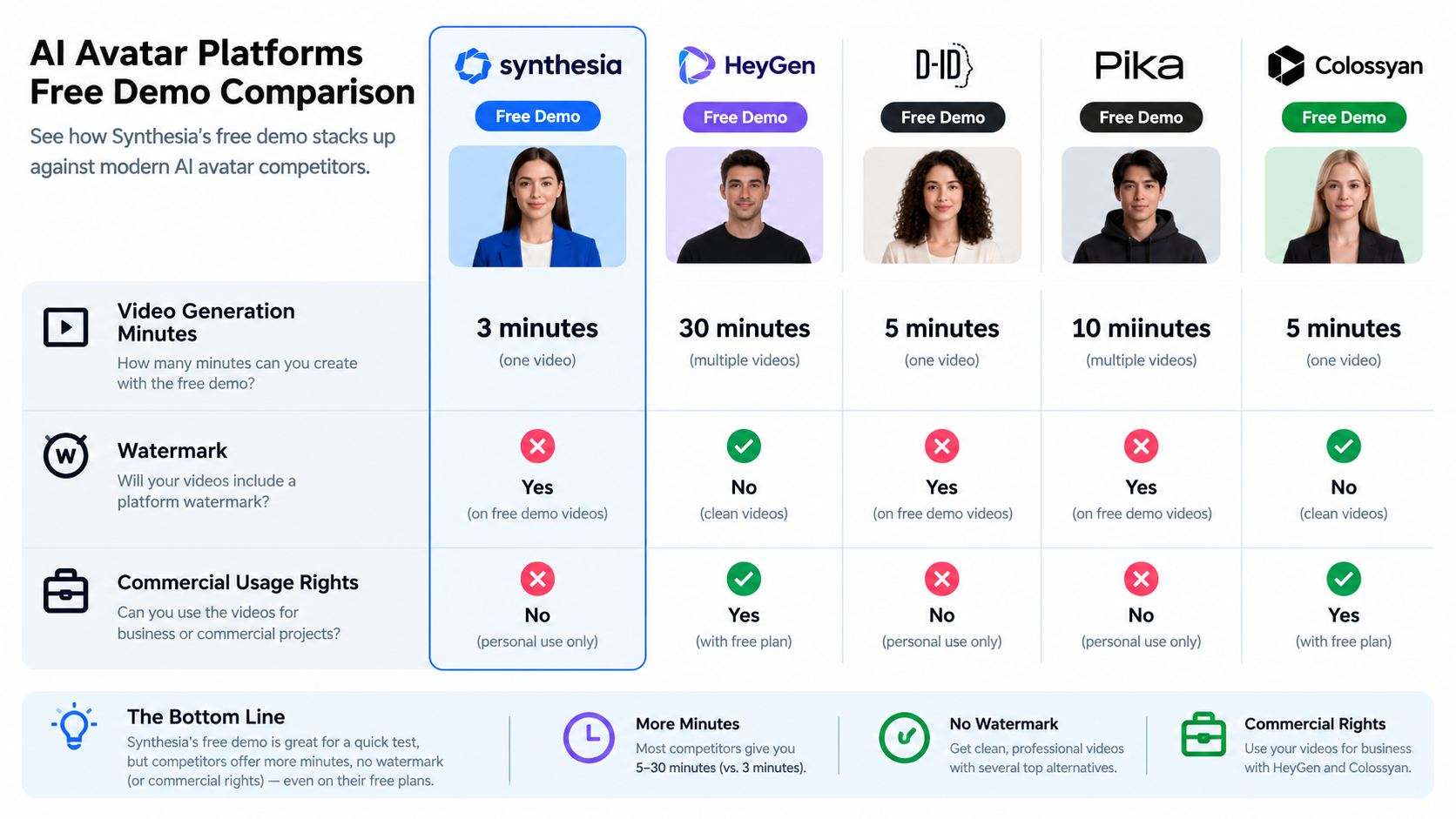
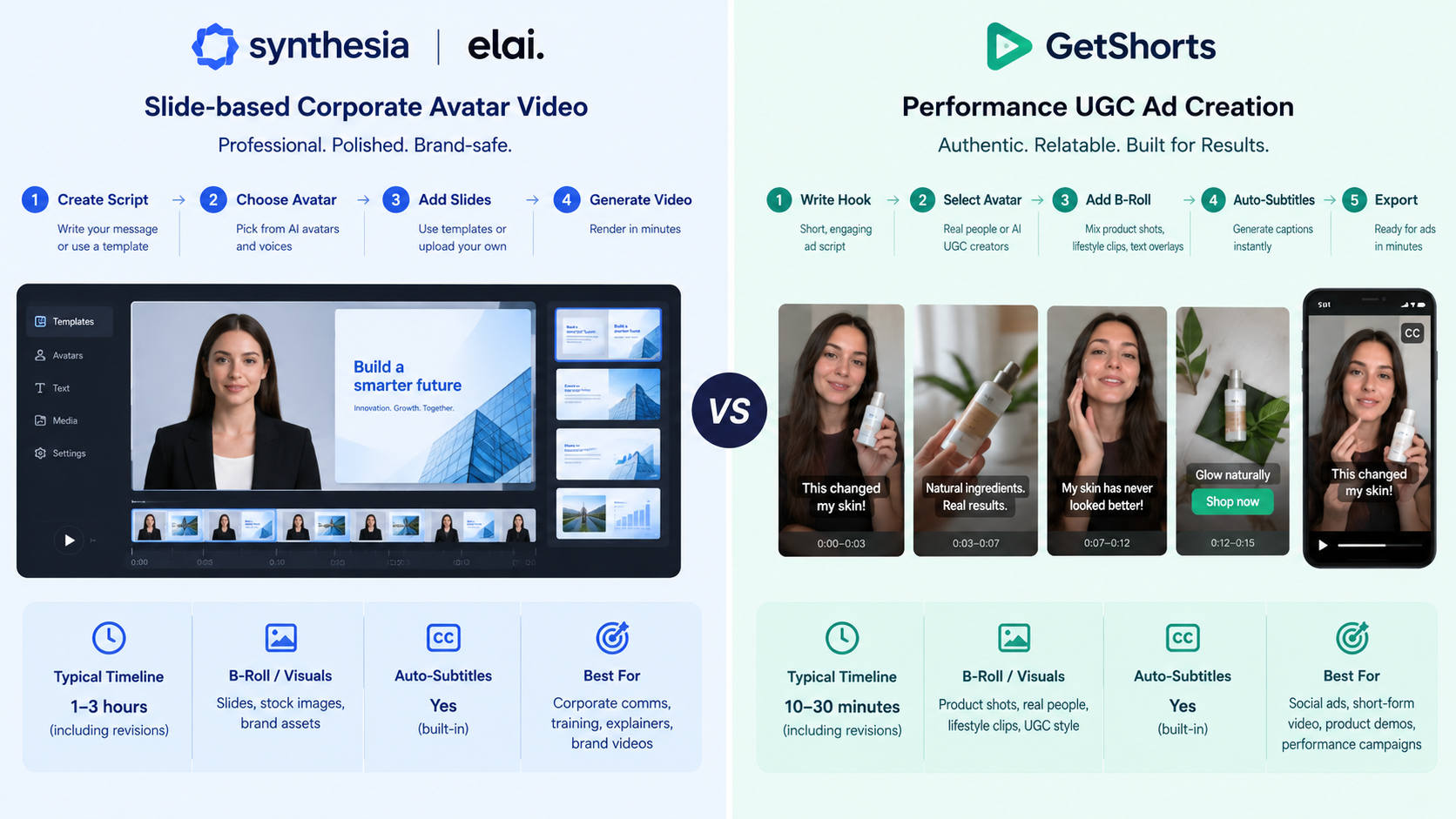
Synthesia does offer a 'free demo' on its homepage, but calling it a true free tier is generous. You can generate a single short clip (capped around 200 characters), cannot download the file without an email verification gate, and the output is stamped with an immovable watermark. Worse yet, Synthesia was built for horizontal, slide-based corporate HR decks—not high-energy, vertical formats needed for TikTok, Instagram Reels, or Meta ads.
When creators sign up for Synthesia, they frequently encounter several operational roadblocks that make the platform impractical for fast-moving social media content:
1. Strict Credit Throttling: On the entry-level Starter plan ($29/month), users receive only 10 minutes of video per month. If you produce 30-second TikTok ads, that allows just 20 short clips—assuming you make zero mistakes and render every draft perfectly on the first try.
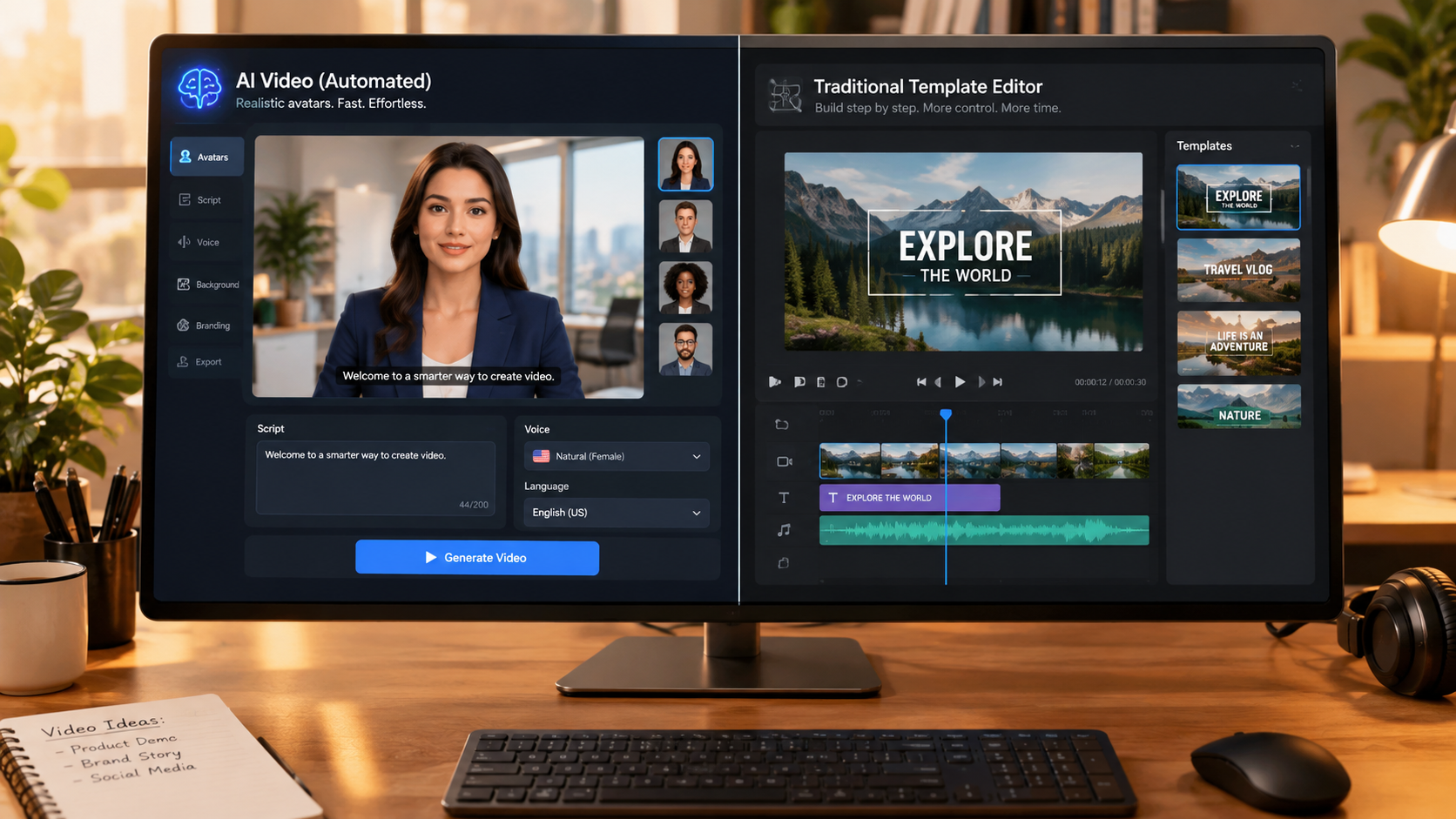
2. Corporate Aesthetic Rigidity: Synthesia avatars look professional, but they look like corporate executives in business suits standing stiffly in front of glass conference rooms. They completely fail the 'organic peer' vibe necessary for UGC ads.
3. Paywalled Custom Avatars: Creating your own digital twin avatar on Synthesia requires moving to high-tier plans with extensive vetting procedures and recurring annual fees.
4. Absence of Social Video Native Features: Synthesia lacks vertical-first timeline controls, automated B-roll insertion, auto-styled viral subtitles, and chat-based scripting assistants designed for ad conversion.
Ready to generate scroll-stopping video ads?
Access organic AI UGC avatars and text-to-speech in minutes.
Test GetShorts Free Today| Platform | Free Offering | Avatar Realism | Vertical / Ad Focus | Starting Paid Tier |
|---|---|---|---|---|
| GetShorts | Free trial + 100% Free Kokoro TTS | Hyper-realistic UGC & Avatars | Built for TikTok/Reels/Shorts Ads | $29/mo (~6 UGC or 40 Story videos) |
| Synthesia | 1-time 200-char web demo | High (Corporate style) | Slide/Horizontal Training focus | $29/mo (limited video minutes) |
| HeyGen | 1 free credit on signup | High (Diverse expressions) | General video & translation | $29/mo (15 credits/mo) |
| D-ID | 5-minute trial credits | Moderate (Still photo animation) | Talking head portraits | $16/mo (basic features) |
| Elai.io | 1-minute free credit | Moderate to High | Article-to-presentation | $29/mo (15 minutes/mo) |
| Colossyan | 5-minute trial credits | High (Workplace focus) | Corporate L&D & onboarding | $27/mo (limited minutes) |
1. GetShorts: The Best Creator-First and Ad-Focused Alternative#
If your goal is to create authentic user-generated content, high-converting social ads, or viral faceless channels, GetShorts is the premier Synthesia competitor. Unlike Synthesia's rigid corporate presentation templates, GetShorts was engineered from the ground up for high-velocity vertical video production.
GetShorts provides a full-featured AI UGC generator, prompt-to-avatar editing, and an automated timeline editor that stitches together realistic avatar speech, dynamic AI B-roll scenes, and auto-styled captions. Furthermore, GetShorts offers a completely zero-cost utility: the Free Text to Speech tool powered by the state-of-the-art Kokoro TTS engine, granting creators a free generation of up to 500 characters every 24 hours with over 20 premium voices, instant MP3 download, and full commercial usage rights without requiring a credit card.
What sets GetShorts apart from legacy avatar tools is its multi-modal creation suite. Marketers can generate videos in Auto Mode (where AI handles scripting and visual assembly automatically), Chat Mode (collaborating conversational style), or the advanced UGC Builder with full multi-track timeline control. You can also upscale avatar visuals with the AI Skin Enhancer or replace audio tracks with the AI Voice Changer.
Unlike Synthesia's steep pricing ramp, GetShorts offers predictable credit tiers designed for performance volume: the Starter plan ($29/month) delivers ~6 UGC videos or 40 Story videos, scaling up to Agency plans ($99/month) that produce 20 UGC videos or 133 Story videos per month. This delivers an effective cost per finished ad of under $5, compared to Synthesia's restrictive per-minute metering.
GetShorts Pros
- •Free trial + 100% free daily Kokoro TTS voice generator with commercial rights
- •Purpose-built for vertical UGC video ads, TikToks, Reels, and Shorts
- •Multi-track timeline editor with automated B-roll and scene generation
- •Clone your face or edit avatar visuals with simple text prompts
- •Affordable transparent pricing with no enterprise paywalls ($29/mo starter)
GetShorts Cons
- •Specialized in short-form vertical video rather than 45-minute horizontal PowerPoint slides
- •Free trial limits high-resolution 4K exports compared to paid tiers
2. HeyGen: The Direct Avatar Competitor With Free Signup Credits#
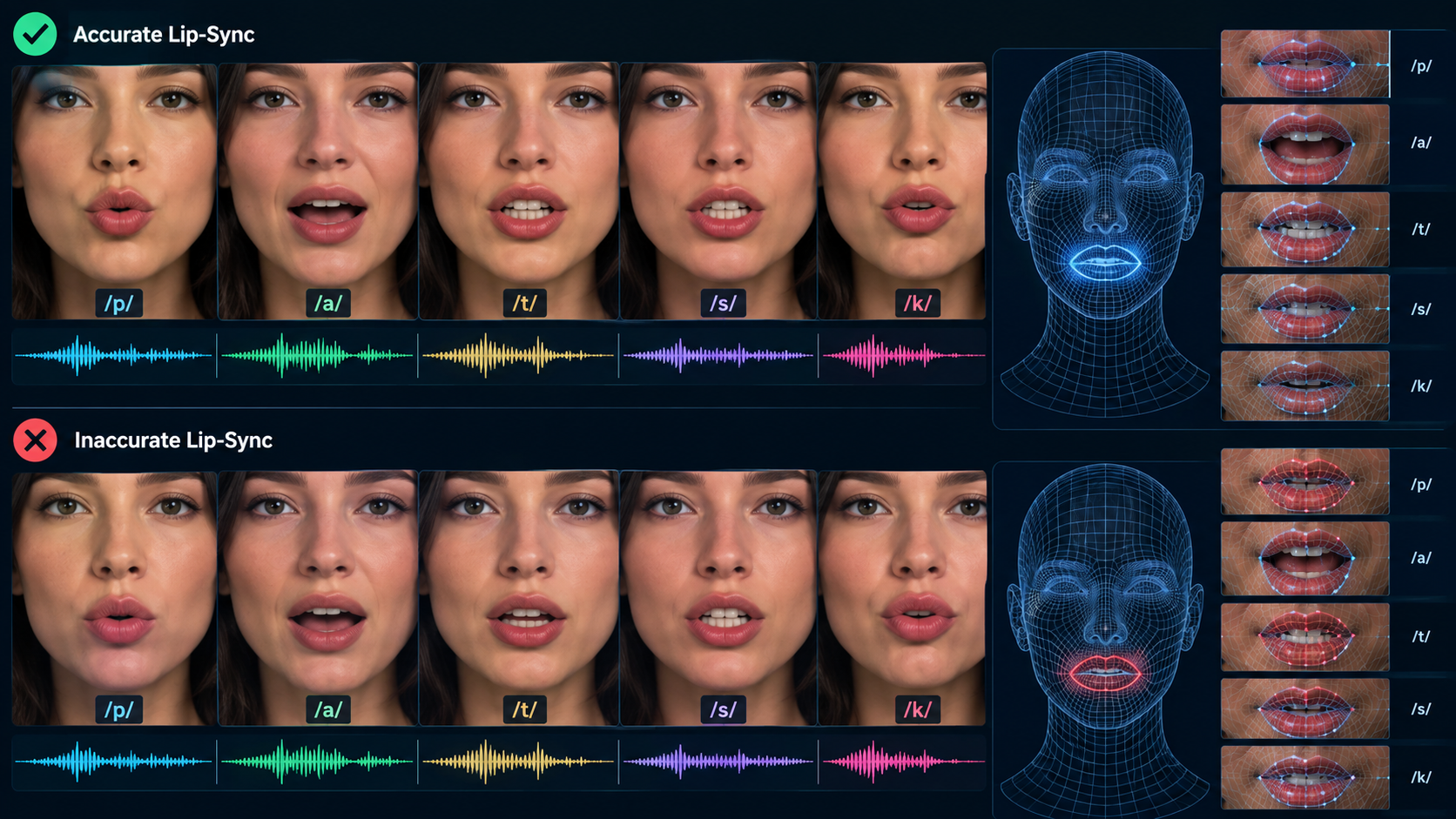
HeyGen is widely considered Synthesia's closest rival in avatar realism and natural facial articulation. For creators looking to test avatar quality without paying immediately, HeyGen provides 1 free credit upon creating an account. This allows you to produce approximately one 60-second video to evaluate their talking-head rendering and lip-sync accuracy.
HeyGen excels at multi-language video translation with automatic voice cloning and lip matching. However, once your single free credit is spent, the platform locks down exports. To see how it compares to other market options, read our detailed review of HeyGen alternatives for AI UGC.
For ongoing production, HeyGen's pricing structure jumps rapidly. Paid tiers start at $29 per month for 15 credits. If your video generation fails due to a script typo or pronunciation glitch, that credit is lost, making trial-and-error iteration costly for budget-conscious creators.
HeyGen Pros
- •1 free trial credit on signup with access to core avatars
- •Industry-leading lip-sync accuracy and natural eye movements
- •Exceptional video translation capabilities with voice preservation
- •Extensive library of studio and casual avatar personas
HeyGen Cons
- •Only 1 free credit, making ongoing free testing impossible
- •Exports on free tier include prominent branding watermark
- •Paid subscription ramps up quickly if you need high video volume
3. D-ID: The Photo-to-Video Talking Head Specialist#
D-ID takes a distinctly different approach from Synthesia. Instead of relying solely on pre-rendered 3D studio avatars, D-ID's Creative Reality Studio allows you to upload any static portrait photograph or AI-generated image (such as a Midjourney character) and animate it with synthetic speech.
D-ID provides a 14-day free trial that includes 5 minutes of video generation time. It is a fantastic option for creators who want to bring historical portraits, illustrated mascots, or custom avatars to life without paying upfront. However, because it animates a 2D still photo, body gestures and head rotations are noticeably stiffer than dedicated full-body avatar platforms.
In performance advertising contexts, D-ID videos can sometimes trigger the 'uncanny valley' response because the head moves while the chest and shoulders stay anchored to the background. It works well for interactive chatbots or quick educational snippets, but less effectively for dynamic social video ads.
D-ID Pros
- •Generous 5-minute free trial window for testing
- •Animates any static photo, digital artwork, or AI-generated portrait
- •Fast rendering times with minimal processing queue
- •Simple, intuitive web interface
D-ID Cons
- •Noticeable uncanny valley effect with rigid neck and body posture
- •Lack of natural hand gestures and physical body movements
- •Not optimized for dynamic social media advertising or timeline editing
4. Elai.io: The Text-to-Presentation Slide Alternative#
If your primary use case for Synthesia is creating corporate training modules, product explainer decks, or translating blog posts into slide presentations, Elai.io is a direct architectural alternative. It features an automated article-to-video feature that extracts key headers and points from a web URL and lays them into slide scenes with an AI presenter.
Elai.io offers a free trial that includes 1 minute of video generation. While the avatar realism is slightly behind Synthesia and HeyGen, its slide layout controls and automated bullet-point transitions make it a favorite for enterprise L&D teams looking for an alternative to Synthesia's restrictive licensing.
The main limitation of Elai.io lies in its rendering speed and audio nuance. Voice cadences can sound slightly mechanical during longer paragraphs, and free-tier users often wait in extended rendering queues during peak server hours.
Elai.io Pros
- •1-minute free trial with access to multiple avatar styles
- •Strong URL-to-video and blog post conversion workflows
- •Built-in presentation slide templates with text animation triggers
- •Supports multi-scene storyboarding
Elai.io Cons
- •Avatar lip-sync can occasionally appear desynchronized on fast speech
- •Limited gesture variety on base avatar models
- •Higher cost per minute on paid plans compared to creator-focused platforms
5. Colossyan: The Workplace Compliance and Scenario Builder#
Colossyan is engineered specifically for corporate training, compliance modules, and customer onboarding. If your company uses Synthesia for internal employee learning, Colossyan offers unique features like multi-avatar conversations—allowing two AI avatars to converse back and forth in the same video scene.
Colossyan provides a 14-day free trial with 5 minutes of video generation. While the tool is powerful for HR scenarios, its templates and avatars are strictly formal. If you try to create a punchy TikTok ad or an Instagram Reel on Colossyan, the output will look excessively corporate and out of place on consumer feeds.
Colossyan Pros
- •5-minute free trial with access to multi-avatar conversations
- •Strong interactive quiz and branching video features for L&D
- •Good multi-language localization with auto-translation
- •Clean, modern slide-based interface
Colossyan Cons
- •Pricing is firmly enterprise-oriented starting at $27/mo for very limited minutes
- •Avatars lack casual emotion, pacing, and viral energy needed for marketing
- •No vertical-first timeline editing or automated social B-roll
The True Cost of Enterprise AI Avatars vs. Creator-First Platforms#
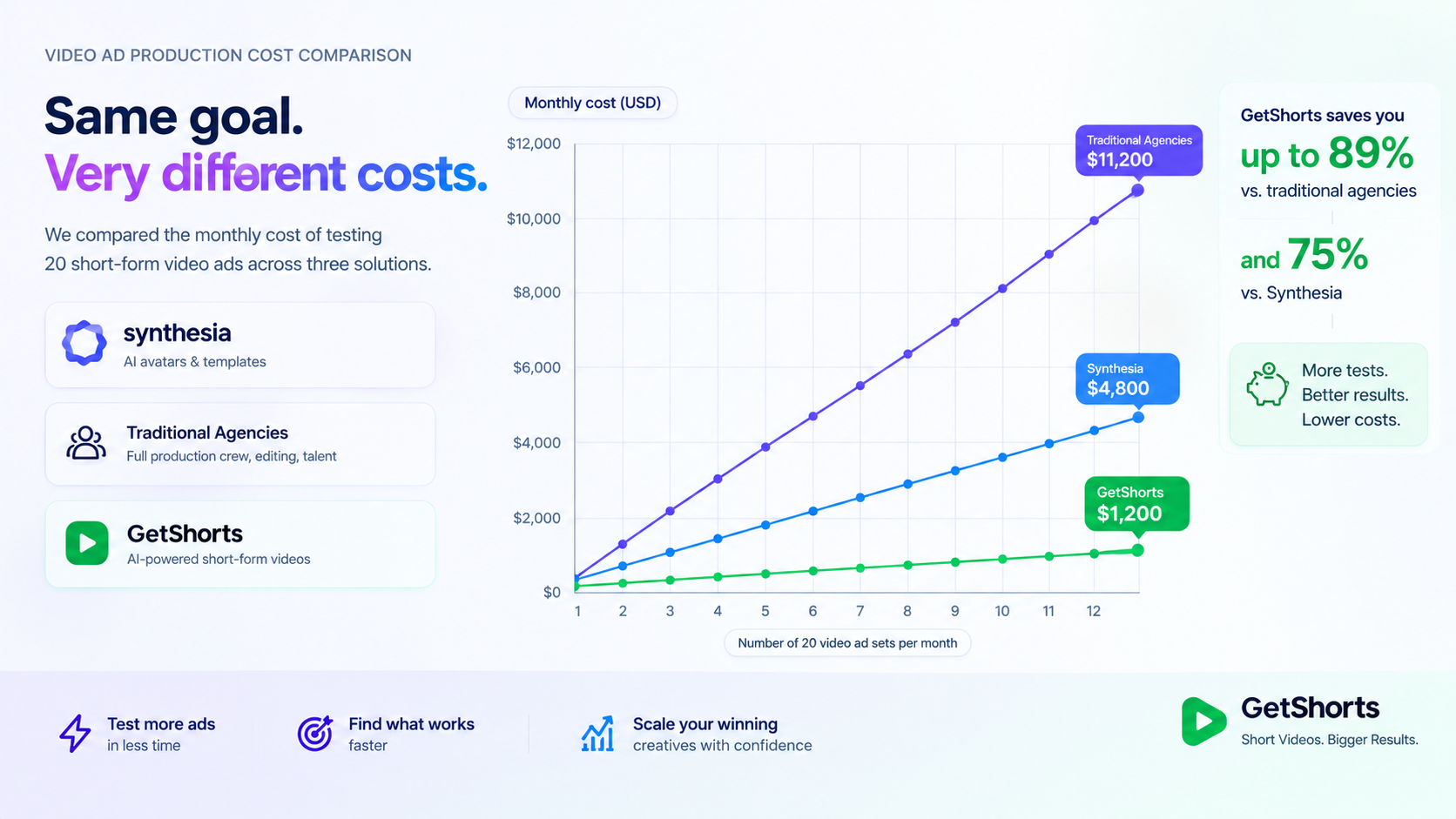
To understand why so many digital marketing teams are moving away from legacy platforms like Synthesia, consider the economics of creative testing. In social video marketing, testing 10 to 15 creative variations per month is the baseline requirement to beat ad fatigue. On Synthesia, 15 variations of a 45-second video consume over 11 minutes of video credit—instantly triggering an upgrade to custom enterprise tiers that can cost upwards of $1,000 per month.
By contrast, creator-first platforms structure their pricing around finished content volume rather than strict per-minute rendering limits. For example, GetShorts includes automated B-roll insertion, script writing, and voice synthesis natively, cutting the cost per usable creative asset by over 80%. When you combine that with zero-cost utilities like the free Kokoro TTS voice generator, your operational break-even happens on day one.
Step-by-Step: How to Create Your First AI Avatar Video Free#
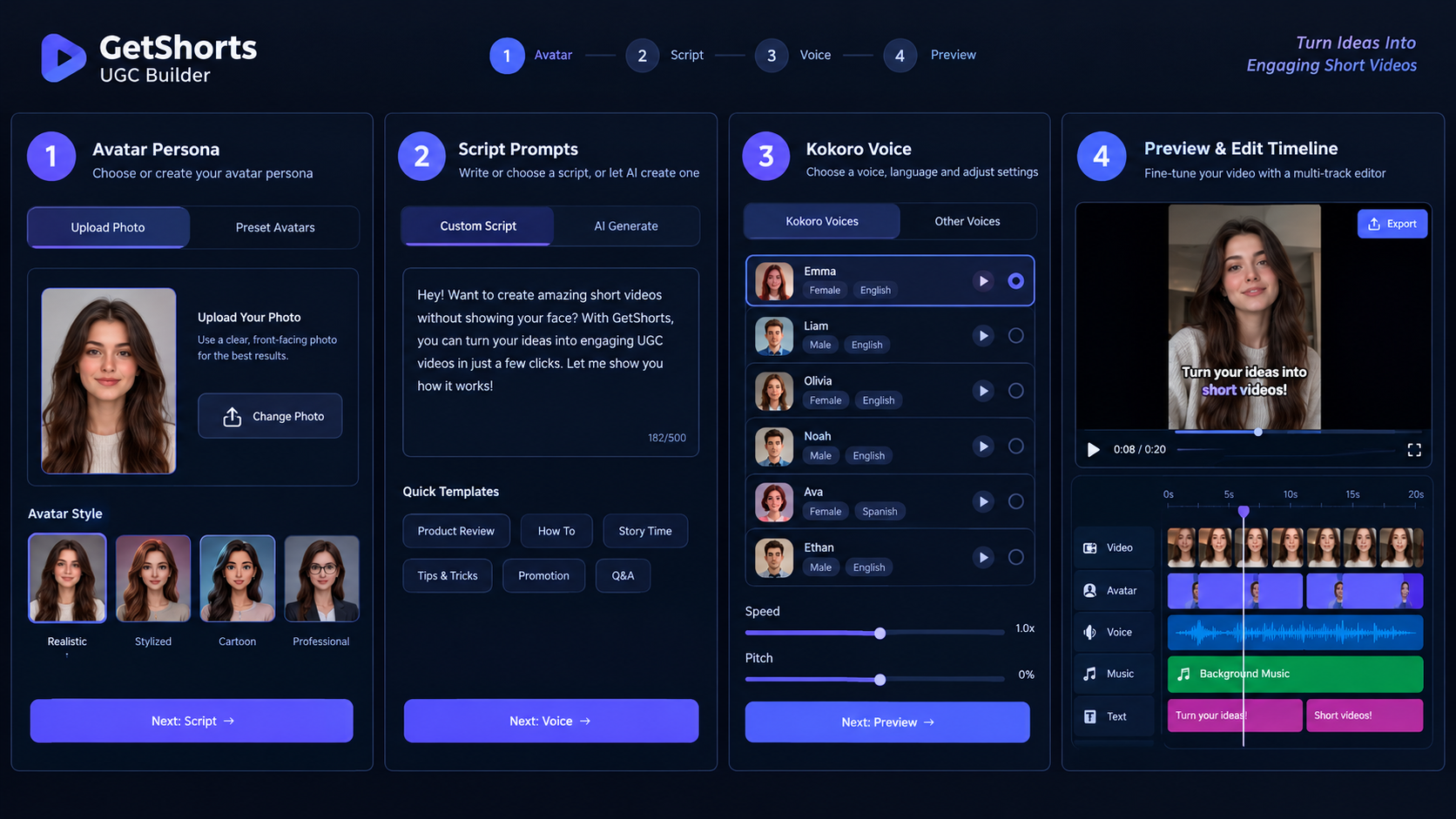
Getting started with modern AI avatar creation requires zero production equipment. Follow this quick 4-step workflow to generate your first video asset:
Step 1: Select Your Avatar Persona
Log into your GetShorts account and open the UGC Builder. Browse the avatar library to find a presenter that matches your target audience in age, gender, style, and energy level. Alternatively, upload a clear photo of yourself to create a custom AI twin.
Step 2: Input Your Script or Use Auto Mode
Paste your copywriting or enter a prompt into Auto Mode to let the AI draft a high-converting problem-solution script tailored for your product niche.
Step 3: Generate Natural Audio and Voice Cadence
Select from over 20+ realistic voices powered by Kokoro TTS and ElevenLabs. Adjust pacing, emphasis, and emotional inflection to match social media conversational norms.
Step 4: Layer B-Roll, Captions, and Export
Use the multi-track timeline to insert cutaway clips over your avatar's speech, add animated auto-subtitles, and export your vertical video in crisp HD ready for TikTok and Meta feeds.
Frequently Asked Questions About Free Synthesia Alternatives#
Can I use free AI avatar videos for commercial advertising?
It depends on the platform. Synthesia and HeyGen strictly restrict commercial use on their free trial tiers. However, GetShorts includes commercial usage rights with its free text-to-speech generations and standard subscription tiers, ensuring your paid ads comply with platform guidelines.
Do free Synthesia alternatives add watermarks?
Most trial tiers (including Synthesia, HeyGen, and D-ID) stamp their logo on free exports. To export clean, unbranded vertical video ads without watermarks, moving to an affordable starter tier ($29/month on GetShorts) provides clean, broadcast-ready files.
What is the difference between 2D photo animation and 3D AI avatars?
2D photo animators (like D-ID) warp a flat image, which often looks robotic when viewed on high-resolution smartphone screens. Full 3D neural avatar engines (used by Synthesia and GetShorts) model the entire facial topology, teeth, tongue, and micro-expressions, creating authentic, lifelike eye contact and natural head movements.
How to Choose the Best Free Synthesia Alternative for Your Needs#
Finding the right alternative depends entirely on what kind of videos you need to produce. If you are producing internal HR onboarding slides or corporate compliance presentations, tools like Elai.io or HeyGen offer direct feature parity with Synthesia without forcing you into enterprise sales calls.
However, if you are a creator, e-commerce brand, or marketing agency producing video ads for TikTok, Instagram Reels, and YouTube Shorts, Synthesia's architecture will hold you back. GetShorts combines hyper-realistic casual avatars, automated B-roll generation, script-to-speech tools, and a multi-track editor built for modern social conversion. Browse our straightforward pricing plans to see how much faster and more cost-effective your video production can be.
Stop Booking Overpriced Creators. Start Scaling UGC Ads.
Produce high-quality AI avatars, auto-captions, B-roll composites and translate scripts instantly. Generate 10+ hook variants for testing.
No credit card required • Start free trial instantly